Accreditation, Assessment and Quality Assurance Policy (NAAC and NBA)
No. 60, Avadi–Vel Tech Road, Avadi, Chennai – 600 062
| Policy Title | Accreditation, Assessment and Quality Assurance Policy (NAAC and NBA) |
|---|---|
| Policy Code | VTHT/ACC/POL/29 |
| Policy Owner | Principal, IQAC, Dean Academics and Institutional Accreditation Steering Committee |
| Version | 1.0 |
| Effective Date | Effective after approval by the competent authority |
| Review Cycle | Once in three years or earlier, whenever required |
| Approving Authority | Governing Council / Management / Competent Statutory Body, as applicable |
| S. No. | Particulars | Page |
|---|---|---|
| 1 | Cover Page | 1 |
| 2 | Document Control and Index | 2 |
| 3 | Introduction, Purpose and Scope | 3 |
| 4 | Objectives | 4 |
| 5 | Guiding Principles and Policy Commitment | 5 |
| 6 | Policy Provisions | 6–12 |
| 7 | Roles and Responsibilities | 13 |
| 8 | Implementation Procedure | 14 |
| 9 | Records, Monitoring, Confidentiality and Non-Compliance | 15 |
| 10 | Review, References and Approval | 16 |
Accreditation is treated as a continuous quality system rather than a periodic documentation exercise. This policy integrates institution-level quality assurance for NAAC with programme-level Outcome-Based Education and accreditation for NBA. It establishes governance, evidence, internal audit, gap closure, stakeholder participation and truthful reporting requirements for all accreditation cycles and applicable transition frameworks.
To maintain continuous institutional and programme readiness for NAAC and NBA, improve educational quality through evidence-based review, protect the integrity of submissions and convert accreditation observations into sustained academic and administrative improvement.
All academic programmes, departments, statutory and non-statutory bodies, IQAC, Controller of Examinations, R&D, placements, student support, administration, finance, library, laboratories, infrastructure, digital systems and stakeholders contributing data or evidence to NAAC, NBA or related quality reviews.
The Institution shall implement this policy through approved roles, adequate resources, documented procedures, transparent communication and measurable review. Decisions and exceptions shall be recorded and authorized by the competent authority.
| Dimension | NAAC | NBA |
|---|---|---|
| Primary focus | Institution-wide quality, governance, academic and support systems. | Quality and outcomes of a specific academic programme. |
| Unit of review | Higher education institution. | Programme/discipline under the applicable tier and manual. |
| Core mechanism | Institutional self-evaluation, quantitative/qualitative evidence, validation and peer review under the applicable framework. | Outcome-Based Education, programme data, SAR, peer review and continuous improvement. |
| Institutional owner | Principal and IQAC. | Principal, Dean Academics, HOD and programme/NBA coordinator. |
Accreditation preparation shall be embedded in normal work. The Institution shall not create retrospective evidence, alter original records or present a pilot activity as a fully institutionalised practice.
The Institution shall comply with the current applicable NAAC framework, including any notified transition to basic/binary accreditation or maturity-based graded accreditation. During transition, IQAC shall maintain evidence compatible with the latest manual and preserve continuity of the established institutional quality domains.
| Quality domain | Institutional controls and evidence |
|---|---|
| Curricular Aspects | Academic autonomy, curriculum design, stakeholder feedback, value-added learning, employability, ethics, environment and cross-cutting issues. |
| Teaching-Learning and Evaluation | Student profile, learner diversity, pedagogy, mentoring, assessment integrity, outcomes, pass/progression and student satisfaction. |
| Research, Innovation and Extension | Research policy, grants, publications, ethics, IPR, incubation, consultancy, extension, collaborations and measurable societal impact. |
| Infrastructure and Learning Resources | Classrooms, laboratories, library, IT, maintenance, accessibility, safety, utilisation and augmentation. |
| Student Support and Progression | Scholarships, capacity building, grievance redressal, placement, higher education, sports, culture, alumni and progression. |
| Governance, Leadership and Management | Vision deployment, participative governance, HR, finance, internal quality assurance, strategy, e-governance and institutional values. |
| Institutional Values and Best Practices | Gender, environment, inclusion, constitutional values, ethics, sustainability, distinctiveness and demonstrably institutionalised practices. |
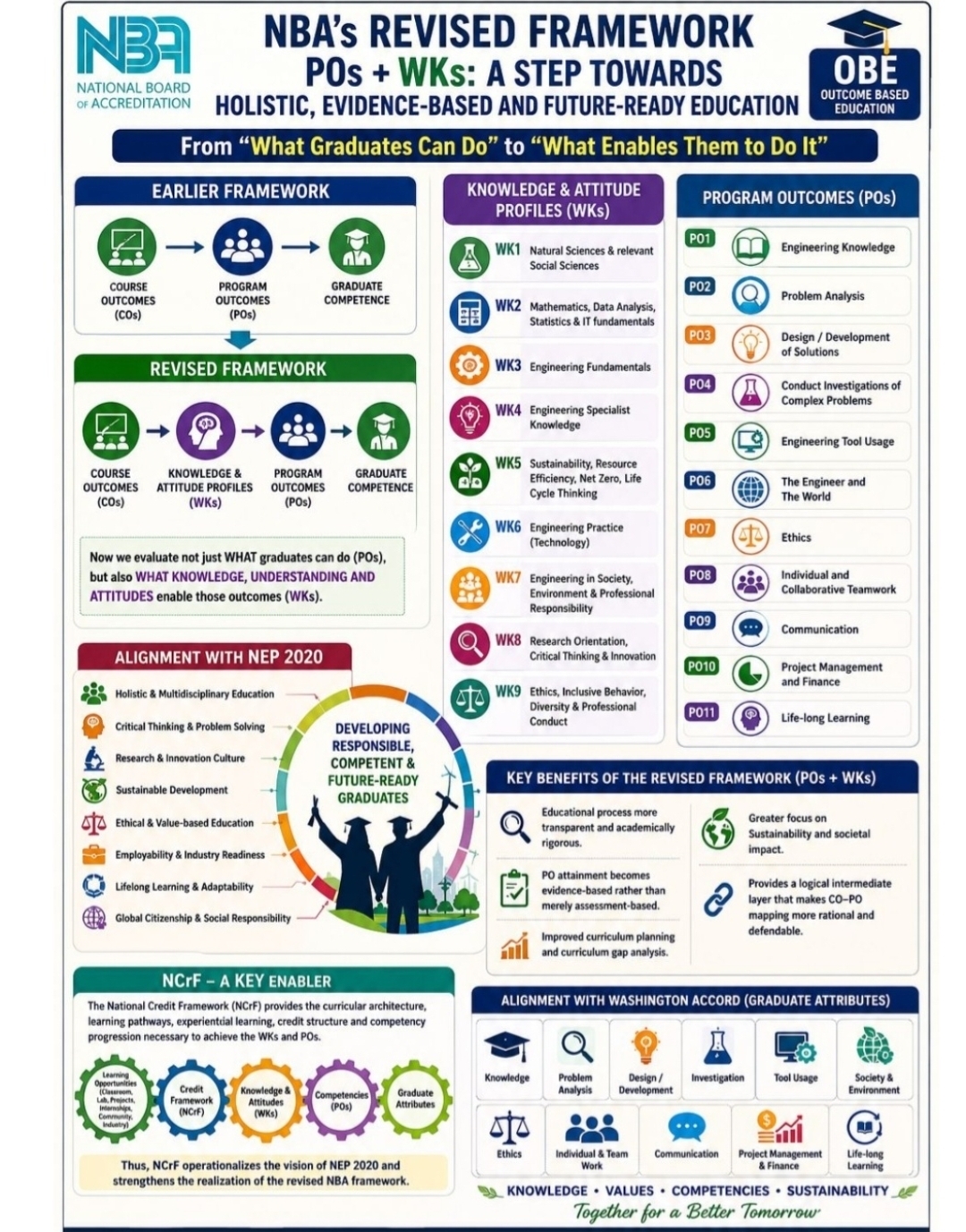
The NBA January 2025 GAPC Version 4.0 SAR for undergraduate engineering programmes places Outcome-Based Curriculum, Teaching-Learning and Assessment at the centre of programme accreditation and introduces explicit Knowledge and Attitude Profiles (WK1–WK9) supporting Program Outcomes (PO1–PO11).
| WK | Institutional interpretation for curriculum and evidence |
|---|---|
| WK1 | Natural sciences applicable to the discipline and awareness of relevant social sciences. |
| WK2 | Mathematics, numerical/data analysis, statistics, computing and information-science foundations. |
| WK3 | Theory-based engineering fundamentals required by the discipline. |
| WK4 | Engineering specialist knowledge, including knowledge near the forefront of the discipline. |
| WK5 | Efficient resource use, environmental impact, whole-life cost, reuse, net-zero and sustainability knowledge for design and operations. |
| WK6 | Engineering practice and technology in accepted practice areas. |
| WK7 | Role of engineering in society, public safety, professional responsibility and sustainable development. |
| WK8 | Research literature, critical thinking, creativity and evaluation of emerging issues. |
| WK9 | Ethics, responsibilities, professional conduct, diversity, inclusion, mutual understanding and respect. |
Programmes shall map curriculum and assessment evidence to WKs where required and shall not treat WK mapping as a purely decorative intermediate layer.
| PO | Outcome area | Evidence emphasis |
|---|---|---|
| PO1 | Engineering Knowledge | Application of mathematics, science, computing, fundamentals and specialisation. |
| PO2 | Problem Analysis | Identification, formulation, literature review and substantiated analysis. |
| PO3 | Design/Development of Solutions | Creative design considering health, safety, lifecycle cost, net zero, culture, society and environment. |
| PO4 | Conduct Investigations of Complex Problems | Experiments, modelling, analysis, interpretation and valid conclusions. |
| PO5 | Engineering Tool Usage | Appropriate modern engineering and IT tools with recognition of limitations. |
| PO6 | The Engineer and the World | Societal, economic, health, safety, legal, cultural, environmental and sustainability implications. |
| PO7 | Ethics | Professional ethics, human values, diversity, inclusion and legal responsibility. |
| PO8 | Individual and Collaborative Team Work | Effective individual, member and leadership performance in diverse teams. |
| PO9 | Communication | Inclusive reports, documentation, presentations and communication across differences. |
| PO10 | Project Management and Finance | Management, economic decision-making and multidisciplinary project execution. |
| PO11 | Life-Long Learning | Independent learning, adaptability and critical thinking amid technological change. |
| Criterion | Control focus |
|---|---|
| 1. Outcome-Based Curriculum | Vision, mission, PEOs, curriculum structure, gaps, POs/PSOs, COs and articulation. |
| 2. Outcome-Based Teaching-Learning | Pedagogy, laboratories, projects, learner support and quality of implementation. |
| 3. Outcome-Based Assessment | Assessment quality, CO attainment, PO/PSO attainment and direct/indirect evidence. |
| 4. Student Performance | Admissions, progression, academic performance, placement, higher studies and achievements. |
| 5–7 | Faculty information and contributions, facilities, technical support and safety. |
| 8. Continuous Improvement | Actions based on CO/PO/PSO results, academic audit and demonstrated improvement. |
| 9. Student Support and Governance | First-year support, mentoring, professional activities, governance, appraisal and outreach. |
Records shall be accurate, retrievable and protected against unauthorized alteration, disclosure or destruction. Access shall be role-based and limited to legitimate institutional need. Retention and disposal shall follow the approved schedule and applicable requirements.
Non-compliance may result in corrective action, withdrawal of access or benefit, recovery of loss, disciplinary action, referral to a statutory body or other proportionate action after due process.
The policy owner shall review this document at the stated cycle or earlier due to changes in law, regulation, institutional structure, technology, risk, audit findings or stakeholder requirements. Amendments shall take effect only after approval and version control.
| Prepared / Coordinated by | Reviewed by | Approved by |
|---|---|---|
| Name & Signature Date: | Name & Signature Date: | Name & Signature Date: |